Sorry for the extra delayed post this week - I'm in LA rehearsing for the Simulacrum Tour with my sister (come and see this show, I think it is going to be very fun).
The music we're playing is synth-y, bit-crunched, wizard sleaze rock n roll. So, naturally, we're playing all the songs in the set along with backing tracks that make all the fun lil computer sounds we as a three piece band cannot. While this frees us from having to sound like 38 midi instruments at once, it does tie us to that underlying click; if we get off, everything falls apart. Practically, this means that, unlike most of the over-jammed and under-rehearsed music I play, there are very precise parts and arrangements that I need to learn and execute in order to avoid utter musical catastrophe.
To handle this learning, I've been spending a few hours every day sitting on the couch and charting out the tunes from the record. This meticulous practice has me thinking a lot about the structure of songs, and the craft of differentiating out separate sections of a song in a way that keeps the track funky and fresh.
This craft of differentiation is something I've been struggling with lately in my own songwriting. It's not too hard for me to sit down and come up with a string of verses, which might contain a couple engaging musical ideas. But it's much harder writing the next section - whether it's a chorus, a hook, or even an interation on the verse - that varies and builds on the foundations of these starter verses. Or, in other sense, I can't find the right context for these fragments - the contrasting image that, when held next to the original verse, will illuminate the lines, accentuating what makes them unique. Without this context, I end up with a pile of half songs that feel flat and unfinished.
When I say differentiation here, I don't just mean in lyrical content - expanding upon the theme of the verse - although that could be part of it. I'm also thinking structurally: about changes in the meter of the lines, the rate at which the chords change, the timbre of the guitar. A lot of the time I think about writing a new section of a song as writing a new but related chord progression, but, in approaching it only from this harmonic point of view, it's easy to write a "new" section which sounds a lot like the existing material.
In mulling this all over, I started thinking about songs that I like, and how they handle these transitions. Or, to start with a narrower question - how does the lyrical structure change between verse and chorus in the songs of the Grateful Dead?
A good starting place to ask this question is the song "Fire on the Mountain". Because the chord progression of the song is both simple and consistent (B to A, and again, through verse and chorus), the sections of the song must necessarily differentiated in other ways. Lyrically1, the first verse starts:
Long distance runner, what you standing there for? Get up, get off, get out of the door
While the chorus is, of course:
Fire, fire on the mountain
The structural difference here isn't hard to see - while both of the sections above take up four musical bars, there are 20 syllables in the first line of the verse, and only 6 in the first line of the chorus. The density of metrical content drops by almost half, increasing the musical space available in the chorus and creating a clear delineation between the two parts of the song.
Another example of this type of pattern can be seen in the song "They Love Each Other", comparing
Merry run around Sailing up and down
which has 10 syllables to
Lord, you can see it's true
which has 6. Again, the syllabic density is almost cut in half here, implying either 1) that each syllable takes up a longer musical duration or 2) that there is more rest space per phrase in the chorus than in the verse.
For both Fire and TLEO, we can see the first force at play in the initial word of each chorus - the word "Fire" takes up two beats, while "Lord" takes up two and a half. By looking at the ends of each phrase, we can see the second force as well; the line in Fire ends with 6 beats of rest, while in TLEO there's a full two bars off before the second phrase of the refrain.
All together, both these songs employ a certain metrical slowing in the transition from verse to chorus. I was curious if this trend held for others Dead songs, so I averaged out the chorus and verse syllable counts for 11 of the top 20 Jerry Garcia songs. The results are as follows:
| Song | Verse syllables per bar | Chorus syllables per bar | Ratio verse to chorus |
|---|---|---|---|
| Bertha | 1.8 | 3.3 | 0.5 |
| Eyes of the World | 2.8 | 3.6 | 0.8 |
| Brown-Eyed Women | 4.8 | 5.4 | 0.9 |
| Friend of the Devil | 6.8 | 6.0 | 1.1 |
| Ripple | 2.3 | 2.1 | 1.1 |
| Sugaree | 3.8 | 3.4 | 1.1 |
| U.S. Blues | 1.9 | 1.1 | 1.7 |
| Franklin's Tower | 4.5 | 2.5 | 1.8 |
| Stella Blue | 1.4 | 0.8 | 1.8 |
| Mission in the Rain | 3.4 | 1.8 | 1.9 |
| Touch of Grey | 3.0 | 1.0 | 3.0 |
It's slightly easier to interpret these numbers graphically. The plot below shows on the x-axis the number of syllables per bar of the chorus; the y-axis the number of syllables per bar of the verse.
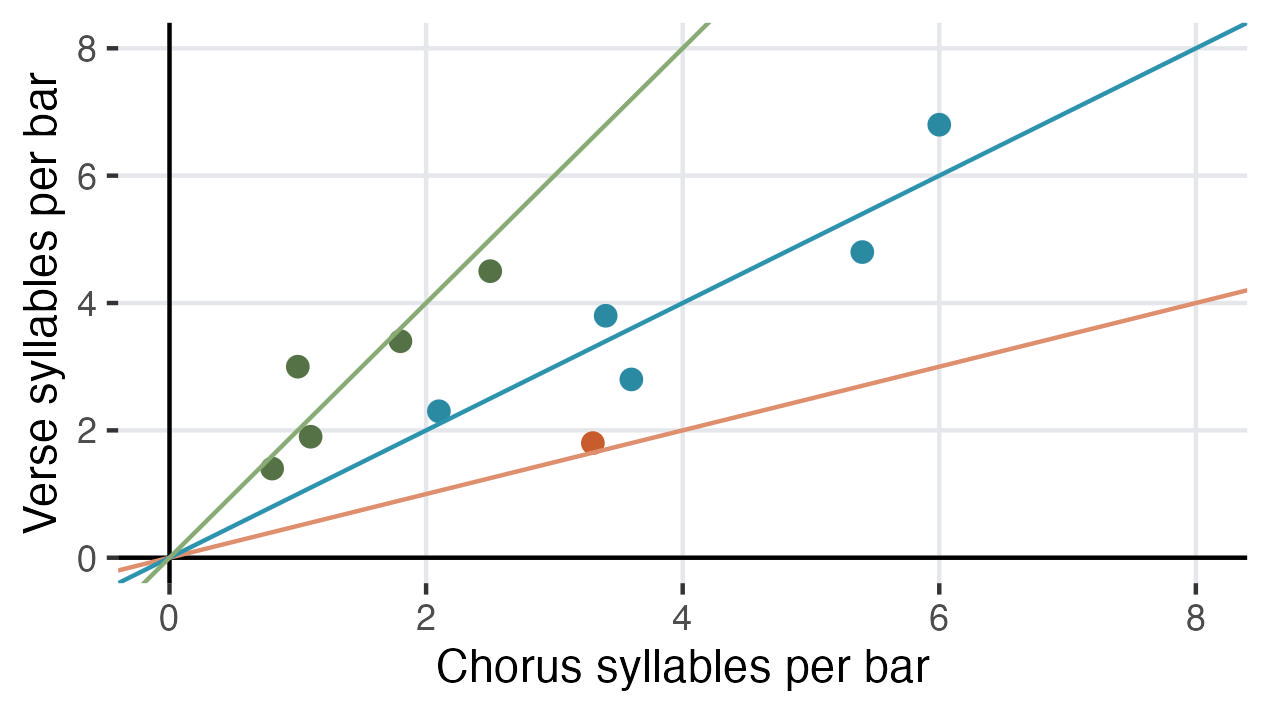
There are three groups that stand out to me here: the five songs in green which have approximately twice as many syllables per bar in the verse as in the chorus; the five songs in blue, which have approximately the same number of syllables in the verse as in the chorus; and the one song in red, which has approximately half as many syllables in the verse as in the chorus.
I was surprised after doing all of this counting that so many of these songs fell in that middle category, with a roughly equal number of syllables per bar in the verse and the chorus. In at least three of these songs, however, the change to the chorus still has an initial slowing of the lyrical pacing:
- In Sugaree,
Shake it, shake it(4 syllables) gets the same number of beats asWhen they come to take you down(7 syllables) - In Ripple,
Ripple(2 syllables) gets the same number of beats asIf my words did glow(5 syllables) - In Brown-Eyed Women,
Brown-eyed(2 syllables) gets the same number of beats asGone are the days(4 syllables)
Even in Eyes of the World, a song where the chorus actually has more syllables per bar than the verse, we see that the melody changes from starting in most verses with some variety of eight note, syncopated phrase ("Right outside", "There comes a", "Sometimes we live") to starting the chorus with a solid quarter note ("Wake"). Similarly for Bertha, we move from the eight note run up of "I had hard run" or "Ran into a rain-storm" to the much more drawn out "I had to mo-o-ove".
What all of this analysis is really getting at is somethign pretty simple; these numbers just indicate that there is a rhythmic change in the melody between the verse and chorus of these songs, often with each syllable in the chorus getting more musical weight than in the verse. This might be a lot of work to get to that point, but it's helpful for me to think specifically about how these changes function. It gives me a new lens to look at these songs through, both as a listener and a songwriter. And, more practically, it's a new technique to try next time I have a half written song and need to make a change.
-
All lyrics from Alex Allan's incredible whitegum.com ↩